
FAQs | Easy morning pick-up & evening drop-off in Yutenji / Naka Meguro, downtown Tokyo | bookings@overlandjapan.com
Easy morning pick-up & evening drop-off in Yutenji / Naka Meguro, downtown Tokyo | bookings@overlandjapan.com
- Bookings | Cancellations | Refunds 1
- Camping Cars | What's Inside 9
- Camping in Japan | How & Where 6
- Insurance | Exclusions | Policies 4
- Office | Hours, Pickup/Dropoff & Requests 6
- Rental Requirements | Driving, License & Rules 4
Bookings | Cancellations | Refunds
What is the cancellation / refund policy?
We try to be as understanding as possible but as we only have a small fleet we are turning customers away once a booking is made for specific dates.
If a paid bookings’ travel dates are wished to be amended or subsequently cancelled, the options and cancellation fee for the original booking will apply as follows:
- If cancelled up to 60 days prior to pick up:
> Full refund or free re-schedule within 6 months within Overland Campers car availability. - If cancelled from 31 to 59 days prior to pick up:
> 20% of Gross Rental Fee OR free one chance re-schedule within six months within Overland Campers car availability - If cancelled 7 to 30 days prior to pick up:
> 30% of Gross Rental Fee. - If cancelled on 2-6 days before pick up:
> 50% of Gross Rental Fee. - If cancelled within 2 days before pick up or No Show:
> 100% of Gross Rental Fee.
PLEASE DON’T BE LATE:
Ensure that you arrive/check in at the agreed pick up time & location decided when the booking is completed. We are a small boutique service and your understanding is appreciated!Late arrivals with notice (email or phone call) may be asked to check in at a later time, pay additional paid parking & staff costs/charges as we attend to other customer check-ins / schedule management
If you are late more than 15 minutes without notice (email or phone call), your booking will be considered a “No Show” then cancelled and no refund will be provided.
Any lateness will be subject to additional fees including paid parking & additional hourly staff costs/wages.
- If Vehicle is returned early: No refund available
- Cancellations due to flight delays or flight cancellations will not be an exception to the cancellation policy
- All cancellations requests should be submitted before 6pm JPST
PLEASE NOTE:
As a small boutique service with a limited number of vehicles each with their own class, cost structure and options offered.
In the unfortunate event due to unforeseen circumstances that a paid booked vehicles becomes unavailable the full paid amount will refunded. In rare cases that an alternative vehicles from our offering is available for the paid booked dates, you may be offered to change vehicle and class (*partial refund or an additional cost may apply based on the alternative vehicle class, cost and options).- If cancelled up to 60 days prior to pick up:
Camping Cars | What's Inside
Are the campers ready for winter driving?
Yes. Winter tyres are fitted to every camper through the winter season — no request needed, no charge.
Winter rentals also include our winter bedding set: a thermal under sheet, high-quality goose down duvet, winter blanket and an electric blanket. A diesel heater that feeds warm air into the rooftop tent is available as an extra.
Japan does a proper winter, and it’s one of the best times to be out in it. Tell us where you’re heading and we’ll let you know what to expect on the roads.
Should we refill / replenish the gas cassettes, cooking condiments, fire-starters, or charge battery when we drop off the camper?
No, these are our gifts provided to you to maximize your experience! You do not need to replenish the gas cassettes, cooking condiments (oil, salt, pepper etc) or charge the battery.
We only require the used kitchen/camping items & inside the camper to be cleaned, your rubbish to be disposed of and the overland camper to be refueled before drop-off.Are the kilometers unlimited?
YES. Our overland campers have unlimited kms, so you can discover all of Japan.
What is included with the seasonal bedding sets?
Our Winter Seasonal Bedding Set (November to March) consists of pillows, a thermal “heat-tech” under sheet, high quality winter goose feather down duvet, winter blanket and an electric blanket;
our Spring Seasonal Bedding Set (April to June) consists of pillows, a high quality goose feather down duvet;
our Summer Seasonal Bedding Set (July to August) consists of pillows, a light weight duvet and electric fan;
our Autumn Seasonal Bedding Set (September to October) consists of pillows, a high quality goose down feather duvet and blanket.
Please NOTE.
For Winter months the supplied electric blanket consumes a large amount of electrical energy and is a limited/finite resource. The amount of “use-time” of electrical blankets & equipment depends on each customers usage, driving time & environment.
If there is concern, it is encouraged that customers book campgrounds offering mains 110V power to charge the supplied portable battery via extension cable.Additionally offer high power hot air heaters that can produce & feed hot air into the roof tents. These can be seen the the “extras” web page and opted for when making a booking request.
We remind that this Overland experience is camping in nature. It is the customers responsibility to pack adequate clothing for individual comfort needs.
What make & model are your Overland camping cars?
We currently have 15 individually built campers across our two bases.
Tokyo — Yutenji / Naka-Meguro
- Toyota Hilux Dual Tent Canopy — White, our only camper sleeping 4 under two rooftop tents
- Toyota Hilux Bush Cabin — Green
- Land Rover Defender 130 Outbound — Metallic Black, 5-door
- Land Rover Defender 110 County — Yellow, 5-door
- Land Rover Defender 110 Tasman — Tasman Blue, 5-door
- Toyota FJ Cruiser Black — 5-door
- Toyota FJ Cruiser Gray — 5-door
- Suzuki Jimny Sierra — 3-door, in Surf, Martini, Black, White, Gray and Jungle Green
Fukuoka — Fukuma, Fukutsu
Every camper is automatic transmission and right-hand drive, and fits in a normal-sized car park.
Fuel economy varies by model — figures for each are listed on the individual vehicle pages.
Please note that all campers have height restrictions because of the rooftop tent, and cannot be parked in underground or covered car parking facilities.
How many people can travel in the Overland camping cars?
Seating is set by the number of seatbelts. Sleeping capacity is set by the rooftop tent — so the two numbers differ on most campers.
Sleeps 4
- Toyota Hilux Dual Tent Canopy — seats 5, sleeps 4 across two rooftop tents. The only camper in our fleet with two separate sleeping spaces, which makes it the one families and pairs of couples usually want.
- Land Rover Defender 130 Outbound — seats 5, sleeps 4 (2 adults and 2 children) in a tent roughly the size of a queen bed.
Sleeps 3
- Land Rover Defender 110 County and Tasman — seat 5, sleep 3 (2 adults and 1 small child) in a double-sized tent.
- Toyota FJ Cruiser — seats 5, sleeps 3 (2 adults and 1 small child) in a double-sized tent. Available in Black and Gray.
- Toyota Hilux Bush Cabin — seats 5, sleeps 3 (2 adults and 1 small child) in a double-sized tent.
Sleeps 2
- Suzuki Jimny Sierra — seats 2, sleeps 2 adults. Tokyo: Surf, Martini, Black, White, Gray, Jungle Green. Fukuoka: Sand, Blue.
Exact tent dimensions are listed on each camper’s page.
What equipment comes with the Overland camping car?
Our most common piece of feedback? “You’ve thought of everything!“
Unlike anywhere else, we take real pride in the planning, design and product quality behind every camper — each item carefully chosen to elevate your whole experience. In fact, over 70 items are included as standard, with no equipment packages or hidden add-on fees.
Every rental includes:
- Rooftop tent and seasonal bedding
- Awning / shade, camping chairs, table and lights
- Fridge, gas stove and a full camp kitchen — pots & pans, chef’s knives, cutting boards, cutlery and an Italian coffee set
- All the little extras you need to cook — lighter, salt, pepper, olive oil, aluminium foil and more
- A speaker for your soundtrack on the road
- An integrated battery power system to charge phones, drones, laptops and cameras, or run a hairdryer (please note this is a finite power resource, so periodic external charging — for example at a powered campground or while driving — may be required)
- A cleaning set, wet wipes and paper towels
…and there’s plenty more. Each camper is fitted out with its own hand-selected kit, so do check the individual vehicle pages for the finer details too.
👉 See exactly what’s packed — the full 70+ item list: What’s Included
What extras can I add to my camper rental?
Every Overland camper leaves fully loaded — over 70 items included as standard, from the rooftop tent, bedding and full camp kitchen to the fridge, awning, integrated battery power system, camp chairs and lights. There are no equipment packages and no hidden add-on fees. (See the full list: What’s Included.)
Available to add
- Child seat — ¥500 per rental. Required by law in Japan for children under six. Tell us the child’s age and weight when you book and we’ll fit the right one.
- Portable air-conditioner — ¥10,000 per rental. Keep cool and sleep easy through the summer heat.
- Diesel heater — ¥15,000 per rental. A portable heater that feeds warm air straight into the rooftop tent — the cosy way to camp through the colder months. Works with any of our campers.
- Awning side wall — ¥8,000 (Jimny) / ¥12,000 (FJ & Defender). A privacy and wind panel that encloses your awning for extra shelter and comfort. (Not a sleeping tent — see swag tents below for extra beds.)
- Single Swag Tent — ¥6,000 / night · Double Swag Tent — ¥9,000 / night. Ground-level tents that add extra sleeping space to your camp (priced per night).
- Projector & screen set — ¥5,000 per rental. Movie nights under the stars — a real trip highlight.
- Pocket WiFi router — ¥650 per day. Stay connected on the road for maps, bookings and sharing the adventure as you go.
- Snow Peak glow stove — ¥5,000 per rental. A beautifully made tabletop stove for warmth and ambience at camp.
- Instax instant camera — ¥2,000 per rental. Capture instant-print memories along the way.
- Bike rack — ¥2,000 per rental. Carries up to two standard bikes, so you can explore further once you’ve parked up.
Complimentary at pick-up — free to borrow (subject to availability)
A few extra touches we’re happy to lend at no charge — just ask our team at check-in:
- Phone chargers & selfie sticks
- Hair dryer
- Binoculars
- Badminton set
- Card games & frisbees
(Complimentary items are offered on a first-come basis and are subject to availability on the day.)
Can I bring my pet with me?
We try our best to allow pets with some of our Overland Camping cars but it really depends on the type of pet, size and your pets sleeping style.
Please tell us about your furry friend and we can advise our best options.
We may charge up-to 10,000yen as a non-refundable pet fee (up to 2 pets allowed).
Camping in Japan | How & Where
Can I charge the sub battery system during my trip?
Yes! Easily at powered camp sites that have Japan standard 110V mains power. To assist, we provide an extension cable for you to charge the sub battery system installed in our Overland camping cars. As a simple guide where power levels are of high concern, we suggest charging at a powered camp site every 2nd evening of your journey.
Note: While we strive to provide high capacity long life energy systems, we have yet to achieve perfect perpetual energy meaning that the sub battery systems are a finite resource where charging is subject to factors such as drive time, individual use-age (appliances), weather, sunlight etc. An alternative device charging method is available all campers with 12V USB charging ports in the front drivers section enabling an additional method for charging while driving (phones, lights, speaker etc).For peace of mind our campers engine starter battery systems are independent of the sub battery system meaning the campers will always start in any sub battery level situation.
Pro Tip. For the fridges while on the go tip is to buy a block/bag of ice from any convenience store placing it in the fridge keeping your food fresh until charge is restored. Easy!
Where can I dispose of my rubbish?
You can dispose your rubbish at willing campgrounds, convenience stores, road-side stations, and some gas stations etc
Garbage/Rubbish in Japan must be divided into 3 key categories: burnable, non-burnable, recyclable.
- Burnable Garbage – Kitchen waste, paper scraps, clothing, etc;
- Non-Burnable Garbage – Metal, glass, ceramics and pottery, etc;
- Recyclable Garbage – Plastic bottles, container jars, cans, newspapers, etc;
Most camping garbage, including kitchen waste and paper scraps, is classified as burnable garbage.
Our TIP! Try to dispose your rubbish regularly in small batches daily along your trip.
Do you have a secure luggage storage service?
Yes, we can arrange a secure luggage storage service for 550yen per item, per calendar day at pick up/check in.
Please Note. We can not store any foods or perishables and can not accept responsibility for any damages / breakages.
Where can I park and sleep in the Overland camping car overnight?
The beauty of traveling in an Overland camping car is the freedom it gives you to get off the beaten path and find camping on the fly. We love hearing about new places and secret spots from our customers!
Ninja Camping / Nature Parking / Wild Camping
Part of the adventure is there are free nature spots and free parking sites along rivers, oceans, mountains found all over Japan for you to secretly discover (and tell us about!).
Legally you can generally park and sleep just about anywhere. However, parking in a busy city might attract negative attention (and not a nice overland experience!) and you could be asked to leave.
The basic rule is if you see other people doing it, it is probably okay. We often find that local hobby fisherman know some of the best spots, so with google maps, try to think where they might be looking for early morning fish!
Auto Camping and Camp Sites
There are more than 1,000 auto camp sites throughout Japan.
Google maps can be your best friend, by finding an area first you can search with the key words “auto camp, auto camping, campgrounds, camping ground or RV park” with a quick check of the photos and reviews you can find some logical options.
Please note that many camp sites require booking in advance especially during national holidays and long weekends in the summer.
Roadside stations (Michi-no-eki) 道の駅
https://www.michi-no-eki.jp/stations/englishMichi-no-eki camping is becoming very popular in Japan and there are communities of people doing this regularly. Michi-no-eki are parking and resting facilities with large free parking areas and clean restrooms that are available 24 hours. There are over 1,000 roadside stations all over Japan. During the day, you can usually purchase local food and souvenirs, and get useful information about the area. Some facilities have hot spring baths and other services. Parking and sleeping at Michi-no-eki is usually okay but the general rule is one night only. You can not take out a table or a chair from your camper and use them. Use of fire such as gas stove and BBQ in the parking lot is generally prohibited. Please observe the rules and good manners when using roadside station facilities.
Service Area / Parking Area
Service areas and parking areas on expressways are facilities to take a rest and are usually equipped with beverage vending machines and clean restrooms that are available 24 hours a day. Service areas are often connected to gas stations and restaurants. You may take a nap, but generally you should not use the facility for overnight stay. You can not take out a table or a chair from your camper and use them. Use of stove or BBQ in the parking lot is prohibited. Please observe the rules and good manners when using service and parking areas.How will I get by without a shower or bathroom in the Overland camping car ?
While our fleet don’t have bathrooms, this is Japan and we highly encourage our renters to enjoy the public baths and onsens that are essential parts of the Japanese bathing culture.
Hot springs have been used for thousands of years in Japan, once for their medicinal purposes as “toji.” They remain popular for their associated many health benefits to this day. Japan is home to many volcanoes, which is why there are more than 20,000 onsen facilities located across the country.
Experiencing various Onsens can become memorable moments of the trip and if you find a great hot tub, please tell us about it so we can share with our other renters.
Alternatively, our renters do just fine using campground facilities, convenience stores and public restrooms, and practicing “Leave No Trace” principles when dispersed camping. It is a matter of your own comfort level, but the freedom that overlanding travel gives you compared to RV’s is worth it for many!
How much storage space is there for luggage?
Check each Overland Camping Car page for luggage space dimensions and suggestions.
As a general rule, travel light if possible—it’ll make your life easier!
We recommend bringing soft-sided bags instead of hard cases as it makes it easier to maximize storage space.If necessary, we are able to arrange a secure luggage storage service for 550 yen per item per calendar day at pick up.
Insurance | Exclusions | Policies
When will I get my security deposit back?
Security deposits are normally refunded 5-7 workings days following the drop off day of your rental camper. This period can be longer if there is a delay with the ETC tolls or a quote for damage repair etc.
How do I pay the security deposit ?
The security deposit must be paid in person at check in by credit card only, the cardholder’s name must be on the booking contract.
What insurance benefits are included?
Our comprehensive insurance coverage is automatically included with every rental. It is provided with a refundable insurance waiver of 200,000yen that is payable at pick-up. This 200,000yen is a partial amount of the total waiver of 480,000yen or 220,000yen if the paid extended waiver is selected at the time of booking inquiry.
The insurance waiver is per incident/accident, not per rental period.
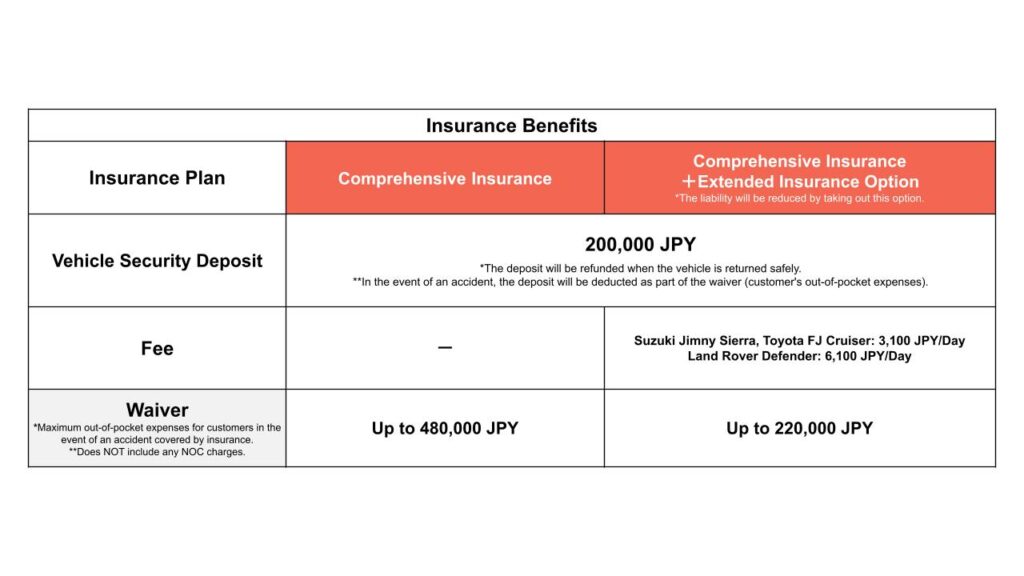
Comprehensive coverage includes;
1. Other Party Liability Compensation (inflicted to someone else)
Bodily Injury; UNLIMITED
Property Damage; UNLIMITED2. Customer Party Compensation (your party injuries)
Bodily/Personal Injury; up to 30,000,000yen (30M)3. Rental Vehicle;
Full coverage for original base vehicle value4. Special Additions;
Roadside Assistance Service
Drive Recorder Dash Cam; (DAP) Drive Agent Personal Service
Attorney Expense Coverage up to 2,000,000yen (2M)
Please note that the provided insurance coverage does not include;
* supplied camping equipment, roof top tent and contents.
* a non-operation charge (NOC)Separate to the refundable waiver, in the event that repairs or cleaning of the vehicle are necessary due to accident, theft, breakdown or defacement, etc., the customer will be charged the following amount as compensation for loss of use for the duration.
(a) Vehicle is driven to scheduled return location; ¥250,000 (tax exempt)
(b) Vehicle is undriveable, not returned to scheduled return location; ¥400,000 (tax exempt)What is included with the Roadside Assistance Service?
All our Overlanders include Japan nationwide roadside assistance support that is available 24/7, 365 days a year.
Features and benefits covered per rental include;
* Roadside response and phone mechanical consultation
* Car towing up 150 kilometers
* Dead / flat battery assistance
* Keys locked inside the car assistance
* Spare tyre changeTotal value of the roadside assistance services included per rental is 150,000yen.
* Please note that roadside assistance services are not covered if any of the rental terms in the agreement are broken or violated and costs would then be the customer’s responsibility.
Office | Hours, Pickup/Dropoff & Requests
What do I need to bring when I collect my overland camper?
When you come to collect the overland camper you should bring with you:
• Legal documents required for Driving in Japan applicable for your country; international drivers permits (IDP) or Japanese translations (JAF) etc.
Please note: only original, physical documents are accepted — printouts, photocopies, and scanned or electronic copies are not permitted.• Driving license of all the named drivers;
• Credit card in the name of the hirer. This should have enough funds to cover the security deposit (200,000 JPY);
• Passport/I.D of all named drivers;
• A self-starting sense of Adventure;
Where are the pickup/return locations for your Overland camping cars?
We have two bases.
Tokyo — Yutenji / Naka-Meguro
A short walk from Yutenji Station (5 minutes) or Naka-Meguro Station (12 minutes), in a quiet corner of Meguro City.
〒153-0065 Tokyo, Meguro City, Nakacho, 2-38-10 西村ビル
Google MapsFukuoka — Hanamigahama, Fukutsu
A lovely coastal spot just north of central Fukuoka — around 15–25 minutes from Hakata and 35 minutes from Fukuoka Airport.
〒811-3216 Fukuoka, Fukutsu, Hanamigahama 1-21-3
Google MapsAll rentals are collected and returned at one of these two bases. One-way trips between Tokyo and Fukuoka are available — contact us to arrange.
What are your office hours and when can we pick up and drop off?
We’re open 8:30am–6:30pm, seven days a week, closed on some public holidays.
Pick-ups and returns run from 8:30am to 6:00pm. The last handover starts at 6:00pm, and takes about 30 minutes — so please arrive by then rather than at closing time.
Can I pick up my Overland camping car early? / Can I drop off late?
Our pick-ups and returns take place within our daily window of 8:30am–6:00pm, seven days a week. Allow about 30 minutes for the handover at each end.
If you’d like to request an earlier pick-up or a later drop-off, note it in the message section when you submit your booking enquiry and we’ll let you know whether it’s possible for your dates.
Please be aware that in most cases we’re unable to accommodate times outside the scheduled window — our check-ins and returns run back-to-back and are prioritised around existing bookings. Where a request can be accommodated, a fee may apply. Please don’t count on an adjusted time until we’ve confirmed it with you.
Can I do one-way trips? Do you offer Overland camping car delivery and drop off services?
Yes, We have 2 locations (Tokyo & Fukuoka)
All rentals need to be pick up and dropped off at one of our locations.What is the minimum number of days that I need to rent an Overland Camping car?
Three calendar days, on every camper in the fleet.
We don’t offer one or two-day rentals — those gaps in the schedule are what let us keep the campers properly maintained and upgraded between trips.
Most customers stay out considerably longer. Japan opens up slowly, and three days is genuinely the minimum rather than the recommendation.
Rental Requirements | Driving, License & Rules
Do I need a driver’s license to rent an Overland camping car?
Yes — everyone who will drive needs a valid, full (non-probationary) driver’s licence, and all drivers must present their documents in person at pick-up. Here’s what to know:
- Minimum age: drivers must be 21 or over. Drivers under 21 or over 70 are welcome, but a higher security deposit and excess apply.
- You also need the right documents to drive legally in Japan. An overseas licence on its own isn’t enough — depending on where it was issued, you’ll need either an International Driving Permit (1949 Geneva Convention) or, for certain countries, an official Japanese translation of your licence, carried together with your passport. Full details (and which applies to your country) are in our FAQ, “Can I drive in Japan with my overseas licence?”
- Originals only — no digital licences, printouts, scans or photocopies. Digital or app-based licences (such as Singapore’s Singpass or Malaysia’s MyJPJ) are not accepted; please bring your original physical licence card. If you only hold a digital licence, request a physical card from your licensing authority well before you travel.
- All drivers must be present at check-in with their own documents to be registered. There’s no extra charge for additional drivers, but only those registered at pick-up (with valid documents) are permitted to drive.
- Living in Japan? A valid Japanese driver’s licence is all you need — no IDP or translation required.
If you’re unsure what applies to you, our “I have a driver’s license from another country, can I rent an Overland Camping Car?” FAQ and the JAF website will point you in the right direction — and you’re always welcome to reach out and ask.
Do all drivers need to be present at the time of pick up?
YES.
All drivers must be present at the time of pick up to present their physical driver’s license and to sign the rental agreement. Electronic versions of the driver’s licenses are not sufficient.It is not possible to add another driver after pickup.
I have a driver’s license from another country, can I rent an Overland Camping Car?
YES — most international visitors can drive in Japan. There are two accepted methods, depending on where your licence was issued. The official details are on the JAF (Japan Automobile Federation) page, and Kart has a handy country-by-country checker:
- JAF — Driving in Japan: https://english.jaf.or.jp/driving-in-japan/drive-in-japan
- Kart — requirements by passport/country: https://kart.st/en/drivers-license/
Method 1 — International Driving Permit (1949 Geneva Convention)
This is the most common route. Obtain an IDP issued under the 1949 Geneva Convention in your home country before you travel. In Japan you must carry all three, together:
- your 1949 Geneva Convention IDP,
- your valid original driver’s licence, and
- your passport.
Please note it must be a 1949 Geneva Convention IDP. Permits issued under the Paris (1926), Washington (1943) or Vienna (1968) Conventions are not valid for driving in Japan.
Method 2 — Official Japanese translation of your licence
If your licence was issued in Switzerland, Germany, France, Belgium, Monaco or Taiwan, you do not use an IDP. Instead, obtain an official Japanese translation of your licence (issued by JAF, or your embassy/consulate — for Taiwan, the Taiwan-Japan Relations Association), following the requirements in the JAF link above. You may then drive in Japan carrying your original licence + the Japanese translation + your passport, together at all times.
⚠️ Physical documents only — digital / app licences are not accepted
You must present the original, physical documents at pick-up. Digital or app-based licences — for example Singapore’s Singpass digital licence or Malaysia’s MyJPJ app licence — are not accepted by the Japanese authorities, by rental companies, or by us. If you only hold a digital licence, please request a physical licence card from your licensing authority well before you travel, as it is not always issued instantly.
How long you can drive (validity)
- An IDP is valid for one year from its date of issue — please check the issue date carefully.
- Your permission to drive in Japan runs for one year from your date of landing in Japan (the entry stamp in your passport) — whichever comes first.
A common trap for long-term residents
If you have resided continuously in Japan for more than one year, your International Driving Permit is treated as invalid, and you will generally need to obtain a Japanese driver’s licence in order to rent a camping car. The National Police Agency explains this clearly with a diagram: NPA driver’s licence guide (PDF)
What age do I need to be to rent an Overland camping car?
You must be at least 21 years of age (at the time of pickup) with a valid driver’s license to rent an Overland camping car
- Bookings | Cancellations | Refunds 1
- Camping Cars | What's Inside 9
- Camping in Japan | How & Where 6
- Insurance | Exclusions | Policies 4
- Office | Hours, Pickup/Dropoff & Requests 6
- Rental Requirements | Driving, License & Rules 4
Bookings | Cancellations | Refunds
What is the cancellation / refund policy?
We try to be as understanding as possible but as we only have a small fleet we are turning customers away once a booking is made for specific dates.
If a paid bookings’ travel dates are wished to be amended or subsequently cancelled, the options and cancellation fee for the original booking will apply as follows:
- If cancelled up to 60 days prior to pick up:
> Full refund or free re-schedule within 6 months within Overland Campers car availability. - If cancelled from 31 to 59 days prior to pick up:
> 20% of Gross Rental Fee OR free one chance re-schedule within six months within Overland Campers car availability - If cancelled 7 to 30 days prior to pick up:
> 30% of Gross Rental Fee. - If cancelled on 2-6 days before pick up:
> 50% of Gross Rental Fee. - If cancelled within 2 days before pick up or No Show:
> 100% of Gross Rental Fee.
PLEASE DON’T BE LATE:
Ensure that you arrive/check in at the agreed pick up time & location decided when the booking is completed. We are a small boutique service and your understanding is appreciated!Late arrivals with notice (email or phone call) may be asked to check in at a later time, pay additional paid parking & staff costs/charges as we attend to other customer check-ins / schedule management
If you are late more than 15 minutes without notice (email or phone call), your booking will be considered a “No Show” then cancelled and no refund will be provided.
Any lateness will be subject to additional fees including paid parking & additional hourly staff costs/wages.
- If Vehicle is returned early: No refund available
- Cancellations due to flight delays or flight cancellations will not be an exception to the cancellation policy
- All cancellations requests should be submitted before 6pm JPST
PLEASE NOTE:
As a small boutique service with a limited number of vehicles each with their own class, cost structure and options offered.
In the unfortunate event due to unforeseen circumstances that a paid booked vehicles becomes unavailable the full paid amount will refunded. In rare cases that an alternative vehicles from our offering is available for the paid booked dates, you may be offered to change vehicle and class (*partial refund or an additional cost may apply based on the alternative vehicle class, cost and options).- If cancelled up to 60 days prior to pick up:
Camping Cars | What's Inside
Are the campers ready for winter driving?
Yes. Winter tyres are fitted to every camper through the winter season — no request needed, no charge.
Winter rentals also include our winter bedding set: a thermal under sheet, high-quality goose down duvet, winter blanket and an electric blanket. A diesel heater that feeds warm air into the rooftop tent is available as an extra.
Japan does a proper winter, and it’s one of the best times to be out in it. Tell us where you’re heading and we’ll let you know what to expect on the roads.
Should we refill / replenish the gas cassettes, cooking condiments, fire-starters, or charge battery when we drop off the camper?
No, these are our gifts provided to you to maximize your experience! You do not need to replenish the gas cassettes, cooking condiments (oil, salt, pepper etc) or charge the battery.
We only require the used kitchen/camping items & inside the camper to be cleaned, your rubbish to be disposed of and the overland camper to be refueled before drop-off.Are the kilometers unlimited?
YES. Our overland campers have unlimited kms, so you can discover all of Japan.
What is included with the seasonal bedding sets?
Our Winter Seasonal Bedding Set (November to March) consists of pillows, a thermal “heat-tech” under sheet, high quality winter goose feather down duvet, winter blanket and an electric blanket;
our Spring Seasonal Bedding Set (April to June) consists of pillows, a high quality goose feather down duvet;
our Summer Seasonal Bedding Set (July to August) consists of pillows, a light weight duvet and electric fan;
our Autumn Seasonal Bedding Set (September to October) consists of pillows, a high quality goose down feather duvet and blanket.
Please NOTE.
For Winter months the supplied electric blanket consumes a large amount of electrical energy and is a limited/finite resource. The amount of “use-time” of electrical blankets & equipment depends on each customers usage, driving time & environment.
If there is concern, it is encouraged that customers book campgrounds offering mains 110V power to charge the supplied portable battery via extension cable.Additionally offer high power hot air heaters that can produce & feed hot air into the roof tents. These can be seen the the “extras” web page and opted for when making a booking request.
We remind that this Overland experience is camping in nature. It is the customers responsibility to pack adequate clothing for individual comfort needs.
What make & model are your Overland camping cars?
We currently have 15 individually built campers across our two bases.
Tokyo — Yutenji / Naka-Meguro
- Toyota Hilux Dual Tent Canopy — White, our only camper sleeping 4 under two rooftop tents
- Toyota Hilux Bush Cabin — Green
- Land Rover Defender 130 Outbound — Metallic Black, 5-door
- Land Rover Defender 110 County — Yellow, 5-door
- Land Rover Defender 110 Tasman — Tasman Blue, 5-door
- Toyota FJ Cruiser Black — 5-door
- Toyota FJ Cruiser Gray — 5-door
- Suzuki Jimny Sierra — 3-door, in Surf, Martini, Black, White, Gray and Jungle Green
Fukuoka — Fukuma, Fukutsu
Every camper is automatic transmission and right-hand drive, and fits in a normal-sized car park.
Fuel economy varies by model — figures for each are listed on the individual vehicle pages.
Please note that all campers have height restrictions because of the rooftop tent, and cannot be parked in underground or covered car parking facilities.
How many people can travel in the Overland camping cars?
Seating is set by the number of seatbelts. Sleeping capacity is set by the rooftop tent — so the two numbers differ on most campers.
Sleeps 4
- Toyota Hilux Dual Tent Canopy — seats 5, sleeps 4 across two rooftop tents. The only camper in our fleet with two separate sleeping spaces, which makes it the one families and pairs of couples usually want.
- Land Rover Defender 130 Outbound — seats 5, sleeps 4 (2 adults and 2 children) in a tent roughly the size of a queen bed.
Sleeps 3
- Land Rover Defender 110 County and Tasman — seat 5, sleep 3 (2 adults and 1 small child) in a double-sized tent.
- Toyota FJ Cruiser — seats 5, sleeps 3 (2 adults and 1 small child) in a double-sized tent. Available in Black and Gray.
- Toyota Hilux Bush Cabin — seats 5, sleeps 3 (2 adults and 1 small child) in a double-sized tent.
Sleeps 2
- Suzuki Jimny Sierra — seats 2, sleeps 2 adults. Tokyo: Surf, Martini, Black, White, Gray, Jungle Green. Fukuoka: Sand, Blue.
Exact tent dimensions are listed on each camper’s page.
What equipment comes with the Overland camping car?
Our most common piece of feedback? “You’ve thought of everything!“
Unlike anywhere else, we take real pride in the planning, design and product quality behind every camper — each item carefully chosen to elevate your whole experience. In fact, over 70 items are included as standard, with no equipment packages or hidden add-on fees.
Every rental includes:
- Rooftop tent and seasonal bedding
- Awning / shade, camping chairs, table and lights
- Fridge, gas stove and a full camp kitchen — pots & pans, chef’s knives, cutting boards, cutlery and an Italian coffee set
- All the little extras you need to cook — lighter, salt, pepper, olive oil, aluminium foil and more
- A speaker for your soundtrack on the road
- An integrated battery power system to charge phones, drones, laptops and cameras, or run a hairdryer (please note this is a finite power resource, so periodic external charging — for example at a powered campground or while driving — may be required)
- A cleaning set, wet wipes and paper towels
…and there’s plenty more. Each camper is fitted out with its own hand-selected kit, so do check the individual vehicle pages for the finer details too.
👉 See exactly what’s packed — the full 70+ item list: What’s Included
What extras can I add to my camper rental?
Every Overland camper leaves fully loaded — over 70 items included as standard, from the rooftop tent, bedding and full camp kitchen to the fridge, awning, integrated battery power system, camp chairs and lights. There are no equipment packages and no hidden add-on fees. (See the full list: What’s Included.)
Available to add
- Child seat — ¥500 per rental. Required by law in Japan for children under six. Tell us the child’s age and weight when you book and we’ll fit the right one.
- Portable air-conditioner — ¥10,000 per rental. Keep cool and sleep easy through the summer heat.
- Diesel heater — ¥15,000 per rental. A portable heater that feeds warm air straight into the rooftop tent — the cosy way to camp through the colder months. Works with any of our campers.
- Awning side wall — ¥8,000 (Jimny) / ¥12,000 (FJ & Defender). A privacy and wind panel that encloses your awning for extra shelter and comfort. (Not a sleeping tent — see swag tents below for extra beds.)
- Single Swag Tent — ¥6,000 / night · Double Swag Tent — ¥9,000 / night. Ground-level tents that add extra sleeping space to your camp (priced per night).
- Projector & screen set — ¥5,000 per rental. Movie nights under the stars — a real trip highlight.
- Pocket WiFi router — ¥650 per day. Stay connected on the road for maps, bookings and sharing the adventure as you go.
- Snow Peak glow stove — ¥5,000 per rental. A beautifully made tabletop stove for warmth and ambience at camp.
- Instax instant camera — ¥2,000 per rental. Capture instant-print memories along the way.
- Bike rack — ¥2,000 per rental. Carries up to two standard bikes, so you can explore further once you’ve parked up.
Complimentary at pick-up — free to borrow (subject to availability)
A few extra touches we’re happy to lend at no charge — just ask our team at check-in:
- Phone chargers & selfie sticks
- Hair dryer
- Binoculars
- Badminton set
- Card games & frisbees
(Complimentary items are offered on a first-come basis and are subject to availability on the day.)
Can I bring my pet with me?
We try our best to allow pets with some of our Overland Camping cars but it really depends on the type of pet, size and your pets sleeping style.
Please tell us about your furry friend and we can advise our best options.
We may charge up-to 10,000yen as a non-refundable pet fee (up to 2 pets allowed).
Camping in Japan | How & Where
Can I charge the sub battery system during my trip?
Yes! Easily at powered camp sites that have Japan standard 110V mains power. To assist, we provide an extension cable for you to charge the sub battery system installed in our Overland camping cars. As a simple guide where power levels are of high concern, we suggest charging at a powered camp site every 2nd evening of your journey.
Note: While we strive to provide high capacity long life energy systems, we have yet to achieve perfect perpetual energy meaning that the sub battery systems are a finite resource where charging is subject to factors such as drive time, individual use-age (appliances), weather, sunlight etc. An alternative device charging method is available all campers with 12V USB charging ports in the front drivers section enabling an additional method for charging while driving (phones, lights, speaker etc).For peace of mind our campers engine starter battery systems are independent of the sub battery system meaning the campers will always start in any sub battery level situation.
Pro Tip. For the fridges while on the go tip is to buy a block/bag of ice from any convenience store placing it in the fridge keeping your food fresh until charge is restored. Easy!
Where can I dispose of my rubbish?
You can dispose your rubbish at willing campgrounds, convenience stores, road-side stations, and some gas stations etc
Garbage/Rubbish in Japan must be divided into 3 key categories: burnable, non-burnable, recyclable.
- Burnable Garbage – Kitchen waste, paper scraps, clothing, etc;
- Non-Burnable Garbage – Metal, glass, ceramics and pottery, etc;
- Recyclable Garbage – Plastic bottles, container jars, cans, newspapers, etc;
Most camping garbage, including kitchen waste and paper scraps, is classified as burnable garbage.
Our TIP! Try to dispose your rubbish regularly in small batches daily along your trip.
Do you have a secure luggage storage service?
Yes, we can arrange a secure luggage storage service for 550yen per item, per calendar day at pick up/check in.
Please Note. We can not store any foods or perishables and can not accept responsibility for any damages / breakages.
Where can I park and sleep in the Overland camping car overnight?
The beauty of traveling in an Overland camping car is the freedom it gives you to get off the beaten path and find camping on the fly. We love hearing about new places and secret spots from our customers!
Ninja Camping / Nature Parking / Wild Camping
Part of the adventure is there are free nature spots and free parking sites along rivers, oceans, mountains found all over Japan for you to secretly discover (and tell us about!).
Legally you can generally park and sleep just about anywhere. However, parking in a busy city might attract negative attention (and not a nice overland experience!) and you could be asked to leave.
The basic rule is if you see other people doing it, it is probably okay. We often find that local hobby fisherman know some of the best spots, so with google maps, try to think where they might be looking for early morning fish!
Auto Camping and Camp Sites
There are more than 1,000 auto camp sites throughout Japan.
Google maps can be your best friend, by finding an area first you can search with the key words “auto camp, auto camping, campgrounds, camping ground or RV park” with a quick check of the photos and reviews you can find some logical options.
Please note that many camp sites require booking in advance especially during national holidays and long weekends in the summer.
Roadside stations (Michi-no-eki) 道の駅
https://www.michi-no-eki.jp/stations/englishMichi-no-eki camping is becoming very popular in Japan and there are communities of people doing this regularly. Michi-no-eki are parking and resting facilities with large free parking areas and clean restrooms that are available 24 hours. There are over 1,000 roadside stations all over Japan. During the day, you can usually purchase local food and souvenirs, and get useful information about the area. Some facilities have hot spring baths and other services. Parking and sleeping at Michi-no-eki is usually okay but the general rule is one night only. You can not take out a table or a chair from your camper and use them. Use of fire such as gas stove and BBQ in the parking lot is generally prohibited. Please observe the rules and good manners when using roadside station facilities.
Service Area / Parking Area
Service areas and parking areas on expressways are facilities to take a rest and are usually equipped with beverage vending machines and clean restrooms that are available 24 hours a day. Service areas are often connected to gas stations and restaurants. You may take a nap, but generally you should not use the facility for overnight stay. You can not take out a table or a chair from your camper and use them. Use of stove or BBQ in the parking lot is prohibited. Please observe the rules and good manners when using service and parking areas.How will I get by without a shower or bathroom in the Overland camping car ?
While our fleet don’t have bathrooms, this is Japan and we highly encourage our renters to enjoy the public baths and onsens that are essential parts of the Japanese bathing culture.
Hot springs have been used for thousands of years in Japan, once for their medicinal purposes as “toji.” They remain popular for their associated many health benefits to this day. Japan is home to many volcanoes, which is why there are more than 20,000 onsen facilities located across the country.
Experiencing various Onsens can become memorable moments of the trip and if you find a great hot tub, please tell us about it so we can share with our other renters.
Alternatively, our renters do just fine using campground facilities, convenience stores and public restrooms, and practicing “Leave No Trace” principles when dispersed camping. It is a matter of your own comfort level, but the freedom that overlanding travel gives you compared to RV’s is worth it for many!
How much storage space is there for luggage?
Check each Overland Camping Car page for luggage space dimensions and suggestions.
As a general rule, travel light if possible—it’ll make your life easier!
We recommend bringing soft-sided bags instead of hard cases as it makes it easier to maximize storage space.If necessary, we are able to arrange a secure luggage storage service for 550 yen per item per calendar day at pick up.
Insurance | Exclusions | Policies
When will I get my security deposit back?
Security deposits are normally refunded 5-7 workings days following the drop off day of your rental camper. This period can be longer if there is a delay with the ETC tolls or a quote for damage repair etc.
How do I pay the security deposit ?
The security deposit must be paid in person at check in by credit card only, the cardholder’s name must be on the booking contract.
What insurance benefits are included?
Our comprehensive insurance coverage is automatically included with every rental. It is provided with a refundable insurance waiver of 200,000yen that is payable at pick-up. This 200,000yen is a partial amount of the total waiver of 480,000yen or 220,000yen if the paid extended waiver is selected at the time of booking inquiry.
The insurance waiver is per incident/accident, not per rental period.
Comprehensive coverage includes;
1. Other Party Liability Compensation (inflicted to someone else)
Bodily Injury; UNLIMITED
Property Damage; UNLIMITED2. Customer Party Compensation (your party injuries)
Bodily/Personal Injury; up to 30,000,000yen (30M)3. Rental Vehicle;
Full coverage for original base vehicle value4. Special Additions;
Roadside Assistance Service
Drive Recorder Dash Cam; (DAP) Drive Agent Personal Service
Attorney Expense Coverage up to 2,000,000yen (2M)
Please note that the provided insurance coverage does not include;
* supplied camping equipment, roof top tent and contents.
* a non-operation charge (NOC)Separate to the refundable waiver, in the event that repairs or cleaning of the vehicle are necessary due to accident, theft, breakdown or defacement, etc., the customer will be charged the following amount as compensation for loss of use for the duration.
(a) Vehicle is driven to scheduled return location; ¥250,000 (tax exempt)
(b) Vehicle is undriveable, not returned to scheduled return location; ¥400,000 (tax exempt)What is included with the Roadside Assistance Service?
All our Overlanders include Japan nationwide roadside assistance support that is available 24/7, 365 days a year.
Features and benefits covered per rental include;
* Roadside response and phone mechanical consultation
* Car towing up 150 kilometers
* Dead / flat battery assistance
* Keys locked inside the car assistance
* Spare tyre changeTotal value of the roadside assistance services included per rental is 150,000yen.
* Please note that roadside assistance services are not covered if any of the rental terms in the agreement are broken or violated and costs would then be the customer’s responsibility.
Office | Hours, Pickup/Dropoff & Requests
What do I need to bring when I collect my overland camper?
When you come to collect the overland camper you should bring with you:
• Legal documents required for Driving in Japan applicable for your country; international drivers permits (IDP) or Japanese translations (JAF) etc.
Please note: only original, physical documents are accepted — printouts, photocopies, and scanned or electronic copies are not permitted.• Driving license of all the named drivers;
• Credit card in the name of the hirer. This should have enough funds to cover the security deposit (200,000 JPY);
• Passport/I.D of all named drivers;
• A self-starting sense of Adventure;
Where are the pickup/return locations for your Overland camping cars?
We have two bases.
Tokyo — Yutenji / Naka-Meguro
A short walk from Yutenji Station (5 minutes) or Naka-Meguro Station (12 minutes), in a quiet corner of Meguro City.
〒153-0065 Tokyo, Meguro City, Nakacho, 2-38-10 西村ビル
Google MapsFukuoka — Hanamigahama, Fukutsu
A lovely coastal spot just north of central Fukuoka — around 15–25 minutes from Hakata and 35 minutes from Fukuoka Airport.
〒811-3216 Fukuoka, Fukutsu, Hanamigahama 1-21-3
Google MapsAll rentals are collected and returned at one of these two bases. One-way trips between Tokyo and Fukuoka are available — contact us to arrange.
What are your office hours and when can we pick up and drop off?
We’re open 8:30am–6:30pm, seven days a week, closed on some public holidays.
Pick-ups and returns run from 8:30am to 6:00pm. The last handover starts at 6:00pm, and takes about 30 minutes — so please arrive by then rather than at closing time.
Can I pick up my Overland camping car early? / Can I drop off late?
Our pick-ups and returns take place within our daily window of 8:30am–6:00pm, seven days a week. Allow about 30 minutes for the handover at each end.
If you’d like to request an earlier pick-up or a later drop-off, note it in the message section when you submit your booking enquiry and we’ll let you know whether it’s possible for your dates.
Please be aware that in most cases we’re unable to accommodate times outside the scheduled window — our check-ins and returns run back-to-back and are prioritised around existing bookings. Where a request can be accommodated, a fee may apply. Please don’t count on an adjusted time until we’ve confirmed it with you.
Can I do one-way trips? Do you offer Overland camping car delivery and drop off services?
Yes, We have 2 locations (Tokyo & Fukuoka)
All rentals need to be pick up and dropped off at one of our locations.What is the minimum number of days that I need to rent an Overland Camping car?
Three calendar days, on every camper in the fleet.
We don’t offer one or two-day rentals — those gaps in the schedule are what let us keep the campers properly maintained and upgraded between trips.
Most customers stay out considerably longer. Japan opens up slowly, and three days is genuinely the minimum rather than the recommendation.
Rental Requirements | Driving, License & Rules
Do I need a driver’s license to rent an Overland camping car?
Yes — everyone who will drive needs a valid, full (non-probationary) driver’s licence, and all drivers must present their documents in person at pick-up. Here’s what to know:
- Minimum age: drivers must be 21 or over. Drivers under 21 or over 70 are welcome, but a higher security deposit and excess apply.
- You also need the right documents to drive legally in Japan. An overseas licence on its own isn’t enough — depending on where it was issued, you’ll need either an International Driving Permit (1949 Geneva Convention) or, for certain countries, an official Japanese translation of your licence, carried together with your passport. Full details (and which applies to your country) are in our FAQ, “Can I drive in Japan with my overseas licence?”
- Originals only — no digital licences, printouts, scans or photocopies. Digital or app-based licences (such as Singapore’s Singpass or Malaysia’s MyJPJ) are not accepted; please bring your original physical licence card. If you only hold a digital licence, request a physical card from your licensing authority well before you travel.
- All drivers must be present at check-in with their own documents to be registered. There’s no extra charge for additional drivers, but only those registered at pick-up (with valid documents) are permitted to drive.
- Living in Japan? A valid Japanese driver’s licence is all you need — no IDP or translation required.
If you’re unsure what applies to you, our “I have a driver’s license from another country, can I rent an Overland Camping Car?” FAQ and the JAF website will point you in the right direction — and you’re always welcome to reach out and ask.
Do all drivers need to be present at the time of pick up?
YES.
All drivers must be present at the time of pick up to present their physical driver’s license and to sign the rental agreement. Electronic versions of the driver’s licenses are not sufficient.It is not possible to add another driver after pickup.
I have a driver’s license from another country, can I rent an Overland Camping Car?
YES — most international visitors can drive in Japan. There are two accepted methods, depending on where your licence was issued. The official details are on the JAF (Japan Automobile Federation) page, and Kart has a handy country-by-country checker:
- JAF — Driving in Japan: https://english.jaf.or.jp/driving-in-japan/drive-in-japan
- Kart — requirements by passport/country: https://kart.st/en/drivers-license/
Method 1 — International Driving Permit (1949 Geneva Convention)
This is the most common route. Obtain an IDP issued under the 1949 Geneva Convention in your home country before you travel. In Japan you must carry all three, together:
- your 1949 Geneva Convention IDP,
- your valid original driver’s licence, and
- your passport.
Please note it must be a 1949 Geneva Convention IDP. Permits issued under the Paris (1926), Washington (1943) or Vienna (1968) Conventions are not valid for driving in Japan.
Method 2 — Official Japanese translation of your licence
If your licence was issued in Switzerland, Germany, France, Belgium, Monaco or Taiwan, you do not use an IDP. Instead, obtain an official Japanese translation of your licence (issued by JAF, or your embassy/consulate — for Taiwan, the Taiwan-Japan Relations Association), following the requirements in the JAF link above. You may then drive in Japan carrying your original licence + the Japanese translation + your passport, together at all times.
⚠️ Physical documents only — digital / app licences are not accepted
You must present the original, physical documents at pick-up. Digital or app-based licences — for example Singapore’s Singpass digital licence or Malaysia’s MyJPJ app licence — are not accepted by the Japanese authorities, by rental companies, or by us. If you only hold a digital licence, please request a physical licence card from your licensing authority well before you travel, as it is not always issued instantly.
How long you can drive (validity)
- An IDP is valid for one year from its date of issue — please check the issue date carefully.
- Your permission to drive in Japan runs for one year from your date of landing in Japan (the entry stamp in your passport) — whichever comes first.
A common trap for long-term residents
If you have resided continuously in Japan for more than one year, your International Driving Permit is treated as invalid, and you will generally need to obtain a Japanese driver’s licence in order to rent a camping car. The National Police Agency explains this clearly with a diagram: NPA driver’s licence guide (PDF)
What age do I need to be to rent an Overland camping car?
You must be at least 21 years of age (at the time of pickup) with a valid driver’s license to rent an Overland camping car